

Nigeria · naira · bank to bank
Money movesthe momentyou mean it to.
xPay moves naira between Nigerian bank accounts — for people paying each other, and for businesses collecting from their customers. No wallet, no float, no balance to top up. The money is in your bank until the second it is in theirs.
Two products, one rail
Which one are you?
xPay GO
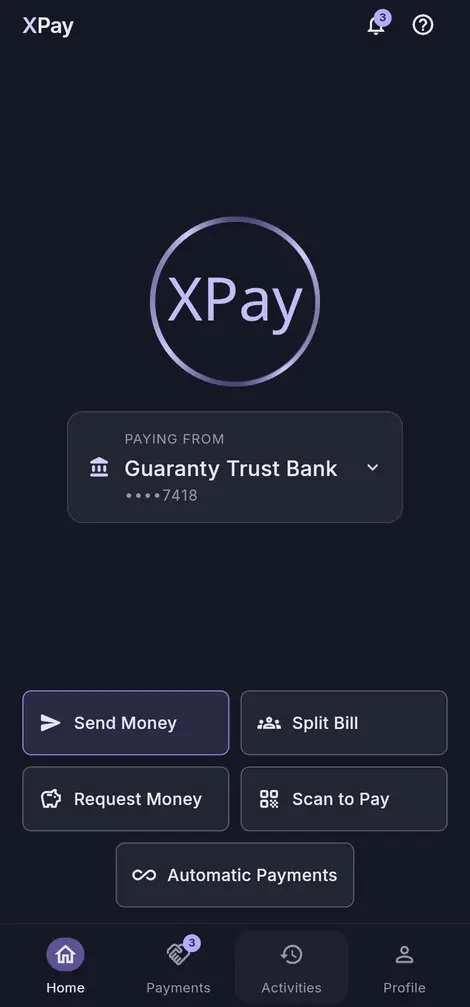
Send money by phone number. Ask someone to pay you back. Split a bill without doing the arithmetic. The recipient’s real name comes back from their bank before you can sign anything.
- Pay anyone with a Nigerian bank account
- Requests, splits and automatic payments
- A four-digit PIN on every payment, every time
xPay Business
Take payments from your own customers — online, by link, at the counter, or on a schedule. One API, one set of credentials, and a rail chosen per payment so you never have to.
- Checkout, pay-by-link, QR and recurring collections
- Direct debit by default, card where speed decides
- A sandbox that simulates the whole lifecycle

Balogun, Lagos. Most of the money xPay moves is this size — a market stall, a transfer, a phone number.
Underneath both
Two instruments. No wallet between them.
Both products reduce to the same two ways of taking money from a bank account, and to the same refusal to hold any of it. xPay has no balance you can be owed, because there is nowhere for a balance to sit.
Direct debit
A mandate the payer authorises with their own bank, once. It does not expire with a card, it needs nothing from the customer at collection time, and it is what every scheduled payment runs on.
Resolves in its own time, like any bank transfer.
Card
Tokenised on the provider’s page — xPay never sees a card number, which is a property of the code rather than a promise about it. It answers in seconds.
The only instrument fast enough for a queue at a till.
The rule
Nothing is called failed until a bank says so.
A timeout is not a decline. A dropped connection is not a decline. A status code nobody has seen before is not a decline. Each of those means the same thing — we could not ask — and every one of them leaves the payment where it is and schedules another question.
Read the other way, a payment that had in fact gone through would be marked failed, the hold released, and the retry would take the money twice. That asymmetry is the single most load-bearing decision in the product, and it is why both halves of every payment are polled rather than assumed.
Start wherever you are.
The app is free to send with, free to ask with and free to split with. Merchant integration starts in a sandbox that moves no real money.